
Learning math and physics on your own feels very different today than it did even 10 or 15 years ago. The raw materials are no longer locked behind tuition paywalls or campus logins. Full university course sites sit in the open.
Peer-reviewed textbooks cost $0. Interactive simulations let abstract ideas move under your cursor. Problem sets exist in quantities that could keep a motivated learner busy for years.
Access is no longer the real barrier. Selection and structure are.
Most people do not stall because math or physics are “too hard.” They stall because the resources do not fit their level, or because the study turns into passive watching instead of skill-building. A workable self-study plan needs more than good lectures. It needs pressure points where thinking happens.
A strong independent setup usually includes four parts:
Today, we prepared a set of reputable, high-authority resources that hold up under serious self-study, from fundamentals through advanced undergraduate topics.
Along the way, you will also see practical ways to combine them into a workflow that produces real progress rather than pleasant distraction.
A High-Quality Resource Stack, At A Glance
Use the table as a quick map. The sections below explain how and why each piece works, plus how to combine them without overload.
| Goal | Best-Fit Resources | Why They Work | Typical Pairing |
| Rebuild math foundations fast | Khan Academy | Structured skill trees, practice, mastery tracking | Add OpenStax Algebra or Precalculus for deeper reading |
| Learn calculus thoroughly | OpenStax Calculus Vol 1–2, Paul’s Online Math Notes | Full scope, many exercises, clear exposition | Add Desmos for graphs, then MIT OCW as a second voice |
| Learn linear algebra for physics | MIT OCW 18.06 (Strang) | Canonical course, strong applications, full structure | Use Python and SymPy for matrix intuition |
| Start physics from scratch | MIT OCW 8.01SC, OpenStax University Physics | Full freshman sequence, strong problem sets | Add PhET simulations and parallel calculus study |
| Electricity and magnetism | Open Yale PHYS 201, OpenStax University Physics Vol 2 | Complete E&M arc with lectures and text | Use PhET circuit and field simulations |
| Conceptual depth | Feynman Lectures (Caltech) | Big-picture intuition and perspective | Companion reading after basics are solid |
If you want a single hub that mixes theory with worked problems, a solid add-on is the math and physical education platform, which organizes topics across mathematics and physics with step-by-step solutions.
Math Resources That Hold Up Under Serious Self-Study
Not all math platforms are built for independent learners, and the resources in this section are the ones that still work when you are studying alone, solving real problems, and checking your own mistakes without outside guidance.
Khan Academy, Best For Structured Practice And Catching Gaps
Khan Academy remains one of the strongest “start where you are” platforms for arithmetic through early calculus. Its biggest strength is not video quality. It is enforced practice. You solve problems, get feedback, and move forward only after showing consistency.
There is also a useful caution here. A randomized evaluation in Brazil covering 157 public primary schools from 2017 to 2019 found improved student attitudes toward math but no average test-score impact.
Outcomes depended heavily on infrastructure and implementation details like individual computer access versus sharing.
For independent learners, the takeaway is practical: practice tools help most when usage stays consistent and friction stays low.
Best use cases
How to pair it
Use Khan Academy for drills and diagnostics. For depth, bring in a full textbook such as OpenStax and work on longer problem sets away from the screen.
OpenStax, The Strongest Free Textbook Backbone
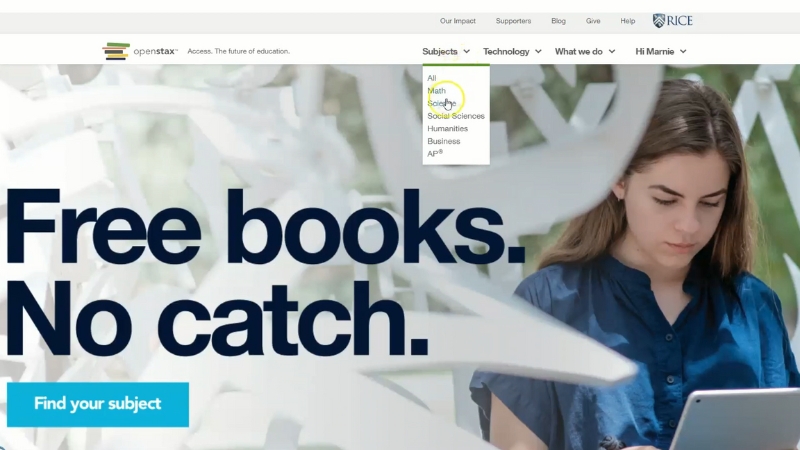
OpenStax is based at Rice University and publishes peer-reviewed textbooks used widely in high school and college courses.
Key math titles include:
- Algebra and Trigonometry 2e
- Precalculus 2e
- Calculus Volume 1
- Calculus Volume 2
For physics, OpenStax offers:
- University Physics Volume 1
- University Physics Volume 2
- University Physics Volume 3
Why OpenStax works
How to use it like a course
- Read one section carefully
- Solve a block of problems without notes
- Label every mistake by type: algebra slip, concept gap, or misread prompt
- Re-solve the same problems two days later
That last step matters more than it sounds.
MIT OpenCourseWare, Best For Real Course Structure
View this post on Instagram
MIT OpenCourseWare offers full syllabi, lecture notes, assignments, exams, and often solutions. That structure replaces the pacing normally supplied by a classroom.
High-value math picks include 18.06 Linear Algebra taught by Gilbert Strang.
High-value physics picks include 8.01SC Classical Mechanics, a complete freshman mechanics sequence.
How people usually misuse it
Many learners watch lectures and feel productive, then stall when problem sets appear.
A better ratio
- 30% intake
- 70% solving, re-solving, and error correction
Treat lectures as setup, not progress.
Paul’s Online Math Notes, Clear Explanations And Many Examples
@nwmxxn i also get additional practices from the website Pauls Online Math Notes. comment down below if i should do more study tips! :)) – #studyvlog #studywithme #StudyTips #foryou #foryoupage ♬ Cool With you sped up – 𐙚˙ena⋆.˚
Paul Dawkins from Lamar University maintains extensive free notes spanning algebra through differential equations.
Paul’s Online Math Notes shine in areas where many learners struggle:
The explanations stay short and direct, with worked examples that reveal how problems actually move.
How to pair them
Use OpenStax as the main text. When a section feels sticky, read the corresponding topic in Paul’s notes and solve a few parallel problems.
Desmos And GeoGebra, Turning Symbols Into Pictures
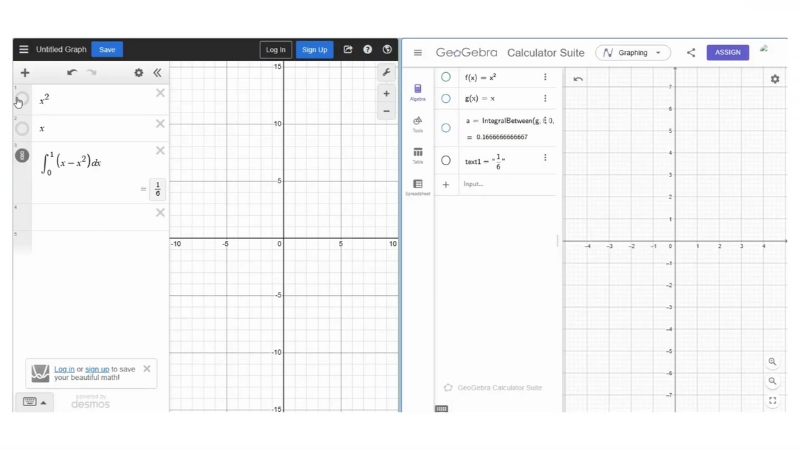
Desmos and GeoGebra reduce the distance between the equation and the meaning.
Practical uses
A few minutes of visualization often saves hours of symbolic confusion.
Physics Resources That Build Intuition And Problem-Solving Power
Physics becomes far more manageable when resources train you to picture forces, fields, and motion clearly while also pushing you to set up and solve problems the way working physicists do.
MIT OCW 8.01SC, A Strong Mechanics Starting Point
MIT OCW 8.01SC Classical Mechanics is a full introductory mechanics course organized around force, momentum, torque, and energy.
Best use cases
Pairing tip
Use OpenStax University Physics Volume 1 as the primary reading source and MIT OCW for pacing and assessments.
Open Yale Courses, Clear And Careful Explanations
Open Yale Courses offers PHYS 200 and PHYS 201 taught by Ramamurti Shankar.
His lectures emphasize derivations and reasoning steps that often get compressed elsewhere. Many self-learners use these lectures as a second pass after reading.
OpenStax University Physics, A Complete Free Sequence
OpenStax University Physics follows standard university sequencing:
Self-study habit that pays off
After every problem, write a one-line setup recipe:
- diagram
- known quantities
- target quantity
- governing law
Build a personal cookbook.
PhET Interactive Simulations, Intuition Builders
PhET Interactive Simulations produces free, research-based simulations.
High-value areas include:
How to avoid wasting time
- Predict outcomes before moving sliders
- Change one variable at a time
- Write plain-language explanations
The Feynman Lectures, Depth And Perspective
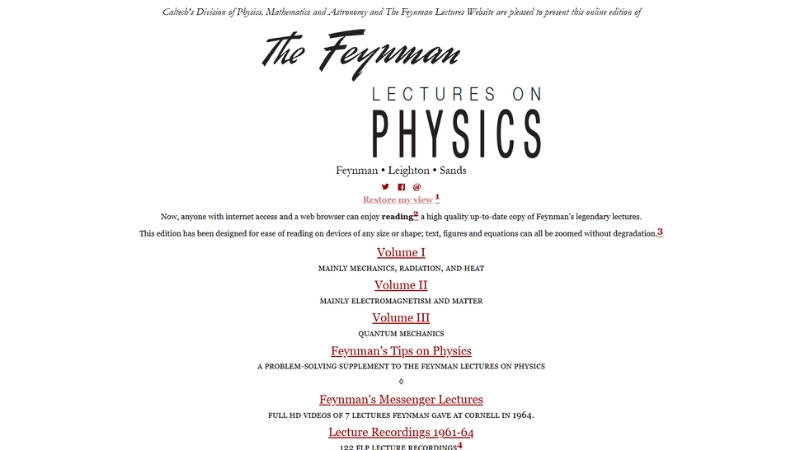
The Feynman Lectures on Physics are hosted online by Caltech, with public notes from the American Physical Society acknowledging their free availability.
Use them as a companion, not a first pass. They shine when you already have basic mechanics and calculus and want conceptual clarity.
Computation Tools That Level Up Self-Study
Once the basics are in place, computation tools step in as quiet partners that catch algebra mistakes, visualize results instantly, and let you experiment the way working scientists actually do.
Jupyter Notebooks, Working Like A Scientist
Jupyter Notebook combine code, equations, narrative text, and plots. They are ideal for checking algebra, visualizing results, and building small simulations.
SymPy, Symbolic Math Without Guessing
SymPy is such an underrated library. https://t.co/GfmpYE4Ul9
— hardmaru (@hardmaru) May 15, 2022
SymPy computes derivatives, integrals, solves equations, and handles matrices symbolically.
Using SymPy to verify intermediate steps reduces silent errors that otherwise pile up unnoticed.
SageMath And Wolfram|Alpha
SageMath supports a wide range of mathematical domains.
Wolfram|Alpha offers fast verification and alternate forms for equations and expressions.
Use them to check work, not replace thinking.
What Good Online Math And Physics Resources Share

Coverage and Sequence
Resources that skip prerequisites cause stalls. Full textbooks and university course pages usually handle sequencing better than short playlists.
Problem Density
Skill grows through solving. A strong resource either includes problems or pairs cleanly with a problem bank.
Multiple Representations
Ideas stick better when you can see them symbolically, graphically, and physically.
Feedback Loops
Feedback can come from solutions, autograded platforms, or computational checks.
A Reality Check On Online Learning
MOOCs carry power and limits. Reviews of MOOC research commonly report completion rates around 5%, with many registrants never starting. Treat enrollment as step zero, not progress.
Plan for attrition. Design routines that survive low-motivation days.
Two Realistic Self-Study Paths
Both paths below are built around realistic time limits, common learning bottlenecks, and the way math and physics skills actually compound when studied outside a formal classroom.
Path A, Math First Then Physics
Best when algebra and functions feel shaky.
1. Algebra and Trigonometry
Khan Academy practice plus OpenStax Algebra and Trigonometry 2e
Desmos for visualization
2. Precalculus
OpenStax Precalculus 2e
GeoGebra for geometry
3. Calculus
OpenStax Calculus Volume 1–2
Paul’s notes for alternate explanations
4. Mechanics
MIT OCW 8.01SC plus OpenStax University Physics Volume 1
Path B, Parallel Math And Physics
Best when algebra manipulation feels comfortable.
Weekly structure
- 3 days calculus
- 3 days mechanics
- 1 day review
Core resources
A Weekly Workflow That Produces Progress
Consistency beats ambition.
Session template, 60 to 120 minutes
How To Judge Progress Without Guesswork

- Use exams: University course pages often include exams. Time yourself.
- Track difficulty: Record how many easy, medium, and hard problems you solve cleanly.
- Expect dips: Motivation fades. Systems keep moving.
Summary
Independent math and physics study works when resources serve thinking rather than replace it.
With open textbooks, full university courses, simulations, and computation tools now public, the real advantage goes to learners who combine them with intention and patience.